|
I have been always keen about analyzing my dreams. I have a lot of dreams, and sometimes I wrote them down. But I have never experienced something close to the movie Inception, UNTIL NOW. So last night I had this dream at 2am. First, I was driving in a parking structure with Mia. Then, there was some kind of space-time transportation and the next thing I know, I was still in the same parking garage but I don't see my car. I have my car keys in my hand, and I tried pressing the remote control but I don't hear anything. But somehow there was a GPS-like device so that I know my car is nearby, maybe on some other levels of the garage. Next scene, I was alone, I found the car! And I was driving it not in the garage but I was driving toward the exit of some residential community. I realized I didn't mean to exit, so I turn back. I was probably anxious looking for Mia, but suddenly my mind played a trick: I suddenly saw that I didn't put my car key in, and yet I was driving. I was so anxious, so realizing this fact, I quickly thought this might be a dream, and I decided I should scream so I'd wake up. And I screamed the crap out of my voice, and I did wake up! Mia was awake by my side and told me I had produced a tiny "ah~" voice like a little lamb!
This is the first time my mind had noticed a loophole in my dream and realized this might be a dream! This is exciting. You see, even though I did think this might be a dream and decided to scream, in the dream, I was pretty sure it was real - when I started screaming I didn't think it was going to work, because I was pretty sure I wasn't in a dream. It's pretty scary. This could be a step toward what they call lucid dreaming - realizing you are dreaming while you're still in there, and try twist the plot as you wish and have fun. It is said it could be used as a self-healing device, but I have never been able to do it.
0 Comments
我从15岁起就读/听恐怖小说。读了很多周德东,第一部是《红都剧院24排4号》, 今天,在十几年以后,又听了。最喜欢的是《我遇见了我》,不是最有名的作品,也很虚无缥缈,确十分有境界。
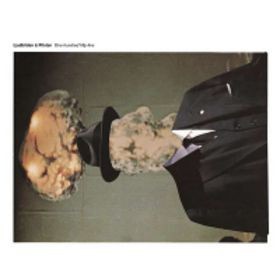
最近蔡骏有很多作品收到关注。听过的有《猫眼》,《夜半笛声》,还有《荒村》。不明白为什么《荒村》收到那么多关注,还拍成了电影。感觉蔡骏主要有几个弱点。第一,他的东西比较derivative,缺少更多原创的点子。比如《荒村》,我感觉就是几个其他小说元素的汇合,包括《夜半》和《猫眼》。这些元素非常典型,包括民国时代的老房子,有魔力的笛子,还有那个重阳节的鬼故事。我并不反对不同作品中出现intertext, 但是后来发现他是的确缺乏原创的点子。 第二, 他也喜欢抄一些其他小说的成功元素,比如盗墓元素,地下迷宫,古墓,军火库,这些都出现在很多小说中-而恰恰是像盗墓笔记这样的成功小说的关键元素。第三,他的套路也比较少,除了前面说的元素之外,还有情节结构,比如很多的恐怖体验都是幻觉,由某种宝石/玉石/声音等控制。第四,就情节来说,《夜半》还说的过去,但是《荒村》实在没有整体感。我对良渚文化挺好奇,但是这个情节实在和故事的整体结构没有任何关系, 最后落脚在玉矿上实在是败笔,和前面对荒村的恐怖渲染完全没有关系。试想,那么恐怖的一个地方,有那么恐怖的故事,最后的巨大的’秘密‘就是那个地方地下有很大的玉矿,这完全和前面渲染的没有半毛钱关系。就好像我给你渲染了半天我要讲一个多么恐怖,多么吸引人的故事,可最后我告诉你那都是梦,不是真的,让人彻头彻尾的失望。不过,比起电影来,这个小说还是强得多。《荒村》电影是我看过的史上最烂的电影。 These are two minimalistic music albums I am very fond of lately (JANUS was a long time ago actually). I don't know if they are labeled as minimalism but it certainly sounded that way. I am Not by Janus and One Hundred Fifty-Five by Ljudbilden & Piloten. These make you feel very cool and logical and calm and peaceful. My favorite in the latter is "Pen on paper" and "Plokk".
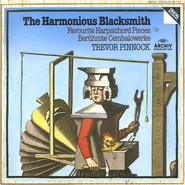 This is an album I stumbled upon, by Trevor Pinnock, the renowned harpsichordist. The title comes from a composition by Handel (although the title was thought to only have come around in 19th century, according to Wikipedia). This is a very nice collection of the gems in harpsichord repertoire, highly recommend.
Once upon a time, I was kind of into this kind of thinking, but that was long time ago. Today, I could not have enough time just learning about new techniques in Java, ML, and data mining, so I have no time to think about this. But anyway here it is, read it for fun.
credit: Brain and Language course, Dept of Neurosciences, Georgetown University, taught by Prof. Mike Ullman, Rhonda Friedman, and Peter Turkletaub.
Questions to be answered for weekly written assignment:
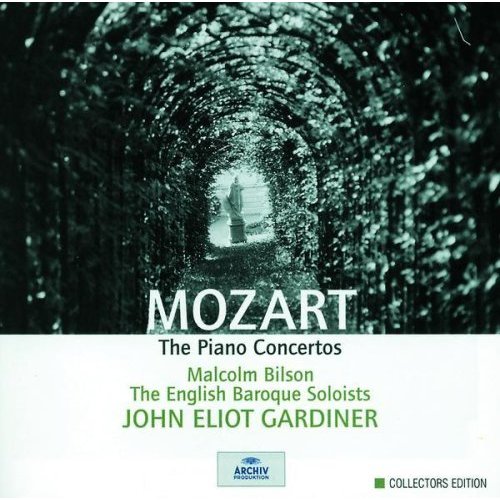
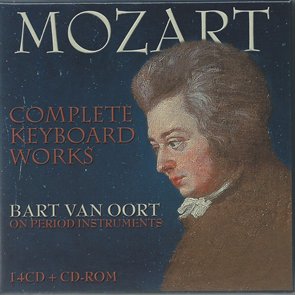
These sets of complete works of Mozart's keyboard music on period instruments have finally been completed for my personal collection. The collection by Bart Van Oort is especially worth mentioning, since it is rather rare to find a complete collection of Mozart's keyboard works (solo) in period instruments, including all works that are of a variety of origin, forms, and genres, such as keyboard sonatas for four hands, dances, young Mozart compositions, and polyphonic music, etc. I stumbled upon this wonderful collection in Barcelona this year. The recording itself is also made of very high quality performance, musicality, instruments, and techniques.
http://www.berliner-philharmoniker.de/en/cinema#anchor-kino-karten You have the opportunity to experience the Berliner Philharmoniker live in a cinema near you three times this season. Be there when the orchestra performs works by Ludwig van Beethoven, Franz Schubert and Igor Stravinsky under the baton of Gustavo Dudamel, when Sir Simon Rattle conducts Johann Sebastian Bach's St John Passion in the staging of Peter Sellars, and when the orchestra interprets together with Daniel BarenboimJohannes Brahms' Piano concerto No. 1. 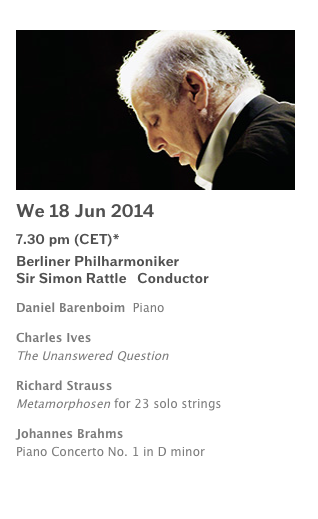
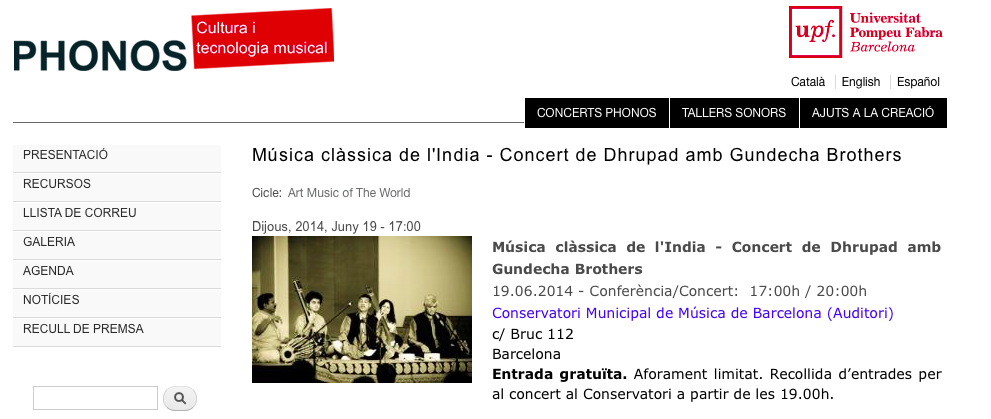
http://phonos.upf.edu/node/869
Hindustani music conert Música clàssica de l'India - Concert de Dhrupad amb Gundecha Brothers 19.06.2014 - Conferència/Concert: 17:00h / 20:00h Conservatori Municipal de Música de Barcelona (Auditori) c/ Bruc 112 Barcelona Entrada gratuïta. Aforament limitat. Recollida d’entrades per al concert al Conservatori a partir de les 19.00h. 17:00h Conferència a càrrec dels Gundecha Brothers: Making of Voice & Raga in Indian Music 19:30h Presentació del projecte CompMusic: a càrrec de Xavier Serra (Music Technology Group) 20:00h Concert de Dhrupad amb els Gundecha Brothers 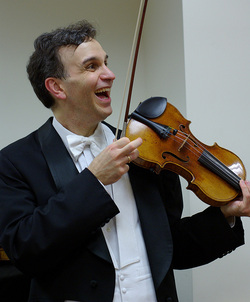 Ah, I'll never forget that smile. That is the smile that got me so much better in 20 minutes after I felt so sick walking into the KC that night.
Gil Shaham, the Iserali-American violinist, is famous since I was in middle school (or before that). Tonight, in 2014, April, I saw him with James Conlon playing with NSO the Korngold violin concerto. Mr Shaham is known for his warmth in his performance. He has a unique manner that you can see in his constant smile and lively facial expressions that conveys his excitement. But in the same time, he delivers the best technique and musical expression with such great ease, not feeling serious at all. Everything he does seemed so easy while it represents some most sophisticated techniques on violin. This is the efficacy of music therapy at its best: my attention was sucked in, in this 20 or so minute concerto, completely by the charms and emotions and techniques of Shaham. I felt a constant amazement and such joy that it made me forgot all about my sickness and whatever may cause me stress in life. This is the best musical performance: the one that heals, but drawing your utter and complete focus and attention to it and enjoying every second of it, even if it only lasts a few minutes, and in the end left you wanting to hear more. The audiences were not super stubborn in hearing an encore, so we hear Brahms' Variation on a Theme by Hadyn next. It was a great work of structure and counterpoint, not to mention that twist about the identity of its theme not being by Hadyn, and the peculiar flavor that atypical 10-measure phrase (5*2) brings. This manifests a point that classical music is best appreciated with cultivated listeners, with knowledge and intellectual satisfaction that helps you understand and be entertained by what's going on. If you don't know anything about the structure, it's just purely boring. That is a point true even for me, who played piano and violin for many years and still finds the easiest time enjoying a piece of solo work or concerto. Other more polyphonic, on the other hand, does require more understanding and work to appreciate. This is also a special concert in the sense that James Conlon, who is a foremost conductor in the world today (and who has conducted several hundreds of Met operas), gave a short introduction (about 4 minutes but feels pretty long, in a good way) about the work performed today. This include his attempt to revive lesser-known works by Alexander Zemlinsky, an Austria-born composer around the turn of the 20th century, and his ties to Alma, Gustav Mahler, and Korngold, and of course, the great Johann Brahms.. |
NEWSLOG
|

 RSS Feed
